A power bank can be powerful enough to charge a laptop and still be the wrong product for a flight. Buyers must check three separate numbers: output power in watts, stored energy in watt-hours, and the laptop's actual charging requirement. Airline and government rules add another layer because permission to carry a battery does not always mean permission to use or recharge it in flight.
A recent r/UsbCHardware discussion began with a 14-hour flight and no expected seat outlet. Most of the visible conversation shifted quickly from brand recommendations to capacity limits and changing airline rules. Thirty-four of 36 visible comment elements were available, making it a useful map of buyer confusion. The individual rule claims still require official verification for the exact airline and route.
Quick answer
For laptop travel, choose a power bank with:
- a clearly printed watt-hour rating;
- USB-C Power Delivery output that matches the laptop's required profile;
- a cable rated for the intended power;
- enough usable energy for the desired runtime;
- a size and condition accepted by the operating airline;
- recognized safety certification appropriate to the market;
- a design that can remain accessible in carry-on baggage.
Always check the operating airline shortly before travel. Rules can vary by carrier, route, aircraft, and jurisdiction, and may change faster than a buying guide.
Watts and watt-hours are different
Watts describe how quickly power can be delivered. Watt-hours describe how much energy the battery stores.
- A 65 W output may be enough to operate or charge many thin laptops.
- A 100 Wh battery describes capacity, not charging speed.
- A 140 W port does not mean the bank contains 140 Wh.
Laptop labels and original chargers provide useful starting points. A laptop supplied with a 65 W USB-C charger may accept lower power while asleep and lose battery during heavy use on a 30 W source. Gaming and workstation laptops may require proprietary or much higher-power adapters and may not accept full charging over USB-C at all.
Convert milliamp-hours to watt-hours carefully
Power banks are often marketed in milliamp-hours. Airlines evaluate lithium-battery energy in watt-hours. The basic conversion is:
Wh = battery voltage × amp-hours
Because 20,000 mAh equals 20 Ah, a pack rated at a nominal 3.7 V is approximately 74 Wh. The manufacturer should print the certified Wh value on the product. Do not rely only on a calculation because internal configuration, labeling rules, and rated capacity can differ.
Avoid a power bank with a missing, damaged, or ambiguous capacity label. Airport staff need a readable rating to evaluate it.
Current U.S. carry-on baseline
The U.S. Federal Aviation Administration says spare lithium batteries and power banks must be carried in carry-on baggage, not checked baggage. The FAA's PackSafe guidance generally allows lithium-ion batteries at 100 Wh or less and describes airline approval requirements for larger 101–160 Wh spare batteries.
The Transportation Security Administration also lists power banks as carry-on items rather than checked-bag items. These are baseline U.S. rules. Airlines can impose additional restrictions, and another country may apply different requirements.
If a carry-on bag is checked at the gate, remove the power bank first and keep it in the cabin as instructed.
Carry permission is not use permission
Some airlines prohibit using a power bank during flight, recharging it from a seat outlet, placing it in an overhead bin, or using it during takeoff and landing. Others require it to remain visible and accessible. The policy may change between outbound and return carriers even on one itinerary.
Before departure, check:
- the airline operating each flight, not only the ticket seller;
- maximum Wh and quantity;
- whether advance approval is required;
- where the bank must be stored;
- whether it may charge a device in flight;
- whether it may be recharged in flight;
- regional certification or labeling requirements;
- rules for connecting flights.
Save the airline policy offline, but follow crew instructions on board.
Match the USB-C PD profile
USB-C is a connector, not a guarantee of laptop charging. Check the output table for voltage and current profiles supported on the specific port. A bank may advertise a high combined wattage while one USB-C port supplies less.
For higher-power USB-C charging, the cable matters. Use a cable rated for the required power and supported standard. Check whether the advertised output is available with one port in use or only as a total shared across several ports.
If the laptop requires a newer extended power range profile, confirm support on the laptop, bank, and cable. Do not infer compatibility from a “140 W” headline alone.
Estimate real runtime conservatively
Not all rated battery energy reaches the laptop. Conversion loss, cable loss, temperature, battery protection, and the laptop's own charging behavior reduce usable energy. A 74 Wh power bank cannot be assumed to add exactly 74 Wh to the laptop battery.
Estimate with a range rather than a promise. If the laptop consumes 20 W during light work, the bank may support several additional hours; if it consumes 70 W during rendering or gaming, the same bank may provide little time and could still allow the laptop battery to fall.
Reduce demand before buying more capacity: lower screen brightness, use offline files, close high-load applications, and charge the laptop before boarding.
Safety and condition checks
Do not travel with a swollen, cracked, recalled, wet, unusually hot, or damaged power bank. Protect terminals from short circuit, keep the bank accessible, and stop using it if it overheats, smells unusual, hisses, leaks, or changes shape. Notify cabin crew immediately if a battery problem occurs.
Avoid charging under pillows, inside tightly packed bags, or where heat cannot escape. Follow the manufacturer's temperature and charging instructions.
Buying checklist
- Read the printed Wh rating.
- Confirm the airline and route rules shortly before travel.
- Match the laptop's USB-C PD voltage and wattage requirements.
- Check per-port output, not only combined output.
- Use a correctly rated USB-C cable.
- Estimate usable energy after conversion losses.
- Confirm weight and size for daily carrying.
- Look for a readable certification label and model number.
- Check recall status and warranty support.
- Keep the bank in carry-on baggage and accessible as required.
Final recommendation
The best laptop travel power bank is not necessarily the largest or fastest model. It is the smallest compliant pack that supplies the laptop's required USB-C profile, delivers enough usable energy for the planned workload, and remains permitted on every flight in the itinerary. Verify the airline again before leaving home.
Related Buyer Voice Lab guides
Sources and research scope
- Public r/UsbCHardware discussion about a power bank for a long-haul flight. Reddit displayed 36 comments; 34 visible comment elements were reviewed. Airline-rule claims were verified only against the official sources below and still require route-specific confirmation.
- FAA PackSafe: Lithium Batteries
- TSA: Power Banks
Rules and carrier policies may change after publication. Check the operating airline and relevant authority before every trip.
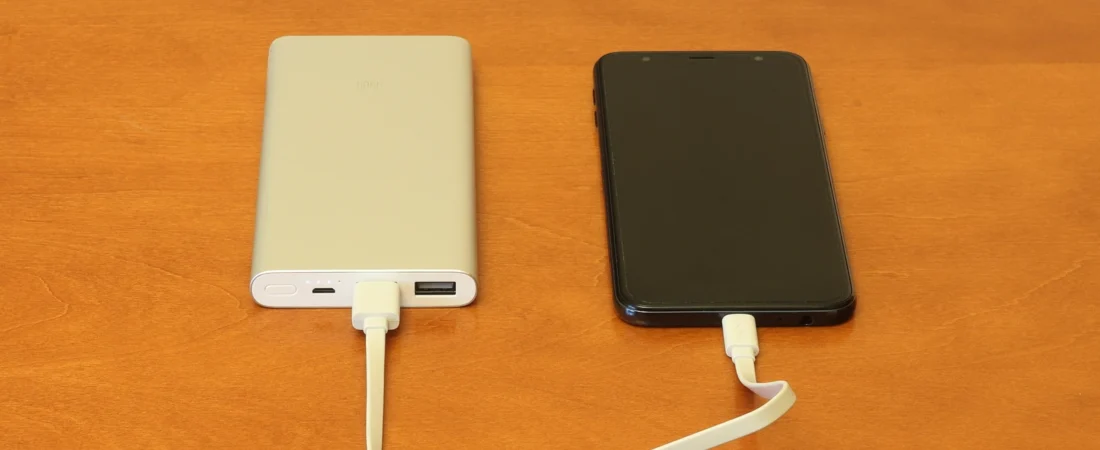
Featured image: “Powerbank Xiaomi, 3” by Cybularny, licensed under CC0 1.0. Original source. Cropped to 16:9.