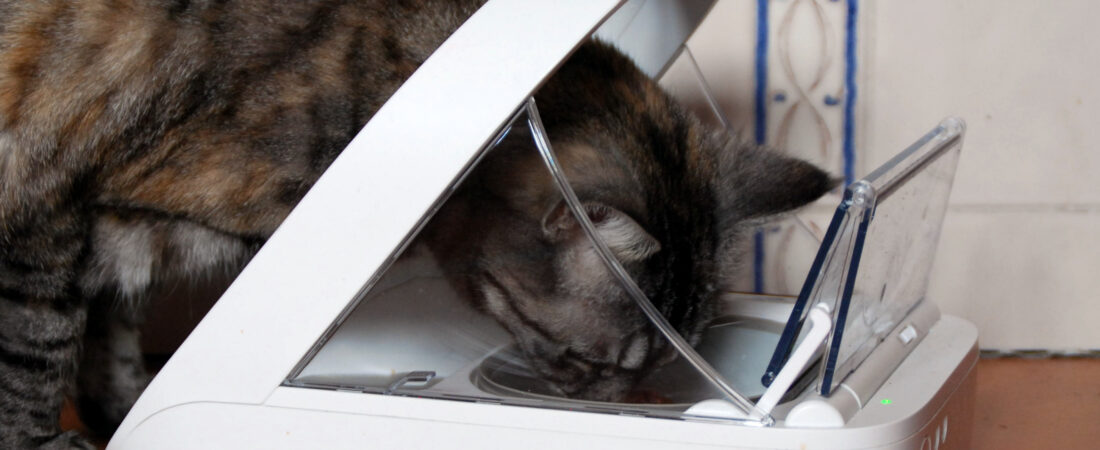
An automatic cat feeder sounds like an easy fix: less begging at breakfast, fewer missed meals, and a cleaner routine when you are away from home. Free feeding sounds even easier: fill the bowl and let the cat decide. For indoor cats, the better option depends on weight, appetite, household routine, food type, and whether more than one cat shares the same space.
The short answer: an automatic feeder is usually better when you need portion control and routine. Free feeding can work for some cats that self-regulate, but it often becomes hard to measure calories, especially with indoor cats, dry food, and multi-cat homes.
What free feeding does well
Free feeding means food is available most or all of the day. It can be convenient for owners with unpredictable schedules. Some cats naturally graze and maintain a healthy body condition this way. Dry food also stays usable longer than wet food, so free feeding is usually tied to kibble.
The problem is that free feeding makes it easy to underestimate intake. A bowl that looks “not too full” may still hold more calories than a cat needs. If the cat is indoors, neutered, less active, or already overweight, free feeding can quietly add weight over months.
What an automatic cat feeder does well
An automatic feeder turns food into measured meals. This helps if your cat wakes you early, vomits after eating too much at once, gains weight easily, or needs food at consistent times while you are at work. It also helps owners test a simple question: is my cat hungry, bored, or trained to ask for food whenever I enter the kitchen?
The best automatic cat feeder for an indoor cat is not the one with the most app features. It is the one that dispenses accurately, does not jam with your kibble size, is easy to clean, and still works if Wi-Fi fails.
When an automatic feeder is worth it
| Household situation | Why a feeder may help | What to check before buying |
|---|---|---|
| Cat begs before breakfast | Meals come from the device, not your reaction. | Quiet motor, reliable schedule, backup battery. |
| Indoor cat gaining weight | Portions become measurable. | Small portion increments and calorie tracking. |
| Cat eats too fast | Meals can be split into smaller servings. | Multiple daily timers and slow-feed options. |
| Two cats share one bowl | Routine helps, but may not solve stealing. | Consider microchip feeders or separate rooms. |
| Wet food is the main diet | Some feeders are less suitable. | Cooling packs, cleaning design, food safety limits. |
What Reddit-style buyer complaints usually reveal
Public cat owner discussions tend to circle around the same practical problems: feeder jams, portions that are not as accurate as expected, cats breaking into the hopper, batteries dying, wet food not staying fresh, and one cat stealing the other cat’s meal. These are not minor details. They decide whether the feeder becomes useful or another gadget in a closet.
If your cat is clever, look for a secure lid and anti-tip design. If your cat eats large kibble, check real buyer comments about jamming. If you have two cats, do not assume one feeder will make food sharing fair.
When free feeding can still be fine
Free feeding can work if your cat maintains a healthy body condition, does not overeat, has no medical diet requirement, and you can still estimate daily intake. Cornell Feline Health Center notes that dry food is convenient for free-choice feeding, while also emphasizing nutrition labels, complete-and-balanced diets, water access, and weight monitoring.
Even with free feeding, measure the daily amount. Put only that amount out for the day. If the bowl is empty too early, avoid simply adding more without checking calories.
A simple decision rule
- Choose an automatic feeder if your cat needs portion control, meal timing, or less owner-triggered begging.
- Choose free feeding only if your cat self-regulates and stays at an ideal weight.
- Use wet food meals separately if hydration, palatability, or urinary concerns matter.
- For multi-cat homes, solve access first. A regular feeder cannot stop a determined food thief.
Bottom line
For many indoor cats, automatic feeders are helpful because they make feeding visible and measurable. They do not replace good food choices, fresh water, play, veterinary care, or weight checks. If your cat is already doing well with free feeding, you may not need to change. If food has become a daily negotiation, a reliable feeder can make the routine calmer for both of you.
Related reading
- Wet vs Dry Cat Food for Indoor Cats
- Cat Water Fountain vs Bowl
- Best Cat Food for Picky Cats Without Wasting Money
- Pet Food Reddit Reviews
Sources consulted
- Cornell Feline Health Center: Feeding Your Cat
- VCA Animal Hospitals: Feeding times and frequency for cats
- Featured image: RFID pet feeder photo on Wikimedia Commons, CC BY-SA 4.0.